
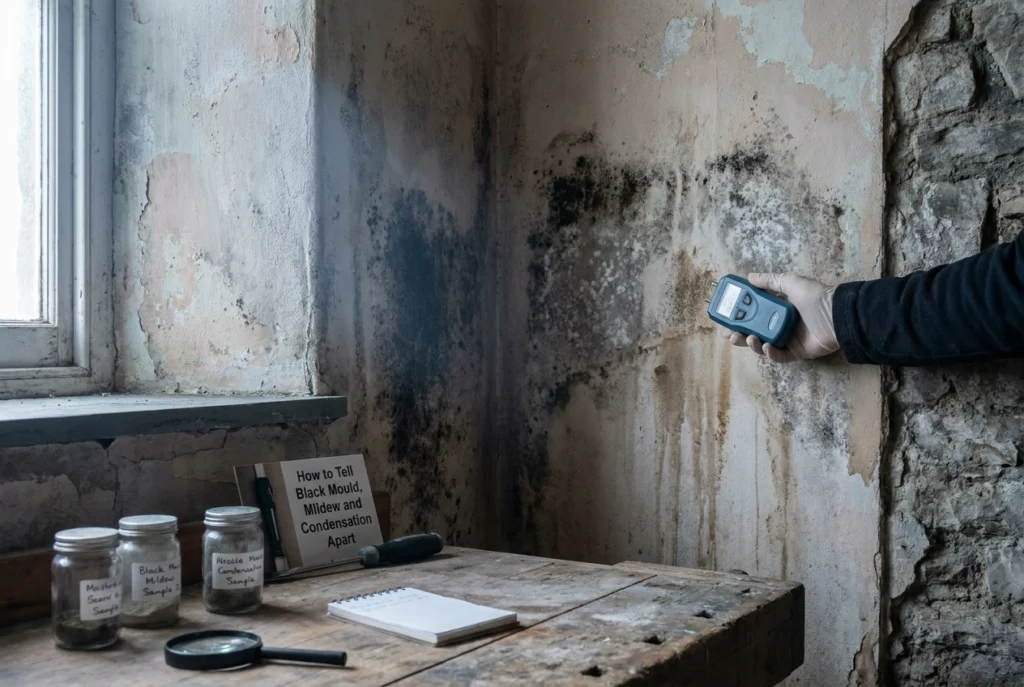
That dark patch on your wall might not be what you think it is. Most homeowners spot a black speck or a grey smudge and immediately assume the worst: black mould. But mildew and condensation staining can look strikingly similar, and each one requires a completely different fix. Treating the wrong problem wastes money, effort and time, and the marks will simply return.
This guide is a practical disambiguation tool. You will learn to read the pattern, colour and location of growth on a wall to work out whether you are dealing with black mould, mildew or condensation staining. We will compare black mould vs mildew side by side, explain what each looks like in real homes, and share five quick checks you can carry out today. You will also learn when markings point to penetrating damp instead, why the wrong diagnosis costs you more in the long run, and what effective treatment and moisture control actually involve. By the end, you will know the right diagnosis before you spend a penny on cleaning or repairs.
Why the Label Matters More Than the Cleaning
Most people call any dark patch black mould, mildew or condensation staining. Each points to a different moisture story, and the treatment that fixes one fails on the others.
Damp is excess moisture that should not be there. Growth is a symptom, so cleaning without finding the source means mould can return quickly.
Penetrating damp, rising damp and condensation are pathways, not casual labels. Genuine DPC failure is rare, and a wrong label steers you to the wrong treatment. Many verdicts are condensation or a leaking gutter instead, so monitor related issues to monitor.
Before spending on products, ask what is feeding the wall, not what it is called. Pattern, colour and location answer that, as this guide walks through.
Black Mould vs Mildew vs Condensation Staining at a Glance
Use this side-by-side comparison to narrow the options.
| Feature | Black mould | Mildew | Condensation staining |
|---|---|---|---|
| Colour | Dark, speckled pin-pricks that spread outward | Lighter, powdery, grey to white | Dark, smudgy tide mark |
| Texture | Furry or velvety | Shallow; wipes away with moderate effort | Residue; not furry |
| Smell | Distinctly musty and earthy | Musty in humid air | Often none |
| Location | Cold surfaces; irregular shape | Humid, poorly ventilated rooms | Cold walls, corners, window reveals |
| Timing | Returns if moisture continues | Appears quickly in stagnant air | Winter mornings; eases as the room warms |
| Likely cause | Ongoing moisture feeding growth | Humidity and poor ventilation | Condensation on cold surfaces |
Appearance descriptions are typical observations; confirm ambiguous cases with professional moisture testing.
Appearance varies with species, surface and age, so treat this as typical rather than definitive. Where the pattern is unclear, a professional survey is the reliable confirmation. For early indicators, see Warning Signs of a Mould Problem. With the three side by side, the checklist and diagnostic steps that follow will help you narrow down your wall.
What Does Black Mould Look Like on a Wall?
Black mould rarely appears as one flat stain. It usually begins as speckled clusters of small dark dots that merge into irregular patches as it grows and releases spores.
Often described as slightly furry or velvety, with areas that appear dry and powdery, established growth resists light wiping. Avoid brushing or hoovering a dry patch, as disturbing dry growth without containment risks spreading it further.
A persistent musty, damp-earth odour in a room with no obvious leak points to active colonisation nearby, often behind furniture. Our guide to the signs you might have mould behind your walls explains what to look for.
Location follows cold surfaces: window reveals, external wall corners, behind wardrobes and beds pushed against outside walls, and around bathroom sealant.
Timing is telling. Growth that can return quickly after cleaning means moisture is still arriving. Beyond a small isolated patch, arrange a professional assessment before treatment, so the source is investigated rather than masked.
Mildew: The Surface Growth People Mistake for Black Mould
Mildew is the surface growth people mistake for black mould. It develops quickly in humid, stagnant air, common in bathrooms, kitchens, utility rooms and rooms where windows stay shut all winter.
Unlike mature black mould, typically, mildew is lighter and powdery, sometimes greyish or whitish before darkening, and sits on top of the surface rather than embedding into it. These are common observations rather than characteristics established by clinical or regulatory guidance. It appears on painted walls, grout, sealant, window frames and fabric, so the same patch looks different on tiles than painted plaster.
Ventilation, Not Water Entry
It usually signals a ventilation and air-quality problem rather than structural water entry, so it responds to moisture reduction, not sealants.
Both are fungi feeding on damp surfaces, so the divide is one of degree and location rather than kind. If unsure, understanding the mould problem starts with the moisture; a survey confirms it.
Do not rely on bleach or heavy scrubbing as a diagnosis; both miss the root cause, and heavy scrubbing risks spreading growth further.
Condensation Staining: Reading the Pattern Most People Misread
Condensation staining is different again. It forms on any surface at or below the dew point of the room air, which shifts with humidity, air temperature and wall temperature. That is why one wall streams on a mild damp morning and another stays dry.
It deposits on walls as described in the comparison table above, dark and smudgy rather than furry. Droplets clearing as the house warms and staining returning each winter are classic signs. Patches in corners, behind furniture and on poorly insulated external walls are condensation, not water entry: these cold spots are where moist air gives up its water.
Growth around window frames or bathroom tiles suggests condensation. Staining cleans more easily than mould once dry, so calling it black mould invites unnecessary chemical treatment. Where a patch grows from one point and worsens after rain, compare the signs of penetrating damp on external walls.
Five Quick Checks to Tell Them Apart at Home
Armed with that pattern, these five checks will usually settle it.
Colour and contrast: note whether the marking is uniformly dark, speckled, powdery or more like a smudged watermark. Photograph it in daylight so you can compare once you have test cleaned a small area.
Texture: press a clean cloth against it. Powdery surface growth transfers easily, established mould resists light wiping, and staining smudges without leaving any real deposit.
Location and pattern: map whether marks follow cold surfaces and corners, hug the base of a wall, or cluster around a window, flue, or a point directly below a gutter or roof defect.
Timing: growth that returns if moisture persists points to ongoing dampness; staining that appears each winter and eases in summer points to condensation.
Smell: a musty odour in the room, cupboard or loft confirms active dampness somewhere, even where the visible patch is small.
Record dates and photographs. That record makes what surveyors look for when checking for damp easier to discuss, and helps landlords and letting agents show an issue was reported and investigated.
If the checks conflict, moisture testing and thermal imaging are the next step.
When the Markings Point to Penetrating Damp Instead
If your checks still conflict, some patterns point outside the room entirely. A patch growing outward from one point, cold and damp to touch and worsening after rain, suggests penetrating damp. Check failed roof coverings, blocked gutters and downpipes, damaged flashing, cracked render, defective window seals and chimney defects. Penetrating damp is often misread as a ventilation problem, so dehumidifiers run while the actual opening in the fabric stays open. These defects hide in hard to reach areas. Drone roof and building surveys allow close inspection of roof coverings, chimney stacks, valleys, parapets and guttering without scaffolding. EX10 provides these across Bournemouth, Poole, Christchurch and wider Dorset, pairing findings with internal moisture readings. If staining sits below a roofline, chimney or gutter run, have the exterior checked before any internal treatment. Learn more about understanding penetrating damp.
Why the Wrong Diagnosis Wastes Money
Wherever the moisture comes from, settle the diagnosis before spending. Every treatment works only if it addresses the actual pathway. Anti-mould washes, sealants, waterproof paints and chemical damp proofing solve different problems, and none solve each other’s.
Misdiagnosis wastes money on the wrong fix. The larger cost is repeat cycles: cleaning, redecorating and replacing damaged plaster, skirting or furniture each time growth returns. A wrong label channels effort and money at the wrong remedy.
Health guidance says moisture should be investigated, not repeatedly cleaned or painted over. WHO notes an increased risk, not certainty, of respiratory symptoms, infections and worsening asthma in damp buildings. Awaab’s Law came into force in October 2025, and government guidance was updated in April 2026, so landlords and letting agents need documented investigation. Frequently asked questions can help, but diagnosis before treatment decides whether your money works.
Condensation Control: Reducing Moisture at the Source
Once the diagnosis points to condensation, the fix is balance: moisture produced, indoor temperature, and how quickly that moist air leaves. Get it wrong and the same cold corners stain again.
Use extractor fans in kitchens and bathrooms, keep trickle vents open, dry washing outdoors or in a tumble dryer, and cover pans while cooking. Housing sector guidance advises not letting a home fall below 18°C. Warmer air holds more moisture before reaching dew point, so a warm, ventilated home is usually drier.
Direct ventilation at the cold surfaces where condensation forms. Opening a window in the next room may not move air past an external wall corner or behind a wardrobe.
When good habits fail, suspect cold bridging, poor insulation or genuinely high indoor humidity. Moisture testing and thermal imaging separate these cleanly. EX10’s condensation control service combines ventilation improvements with moisture measurement, so recommendations reflect your property. Book at www.ex10.com or call 01202 790212.
Black Mould Treatment: What Works and What to Avoid
Better ventilation reduces moisture, but where growth has taken hold, treatment follows a fixed order.
Treat the moisture first, then the growth. Cleaning a damp wall is cosmetic; regrowth returns if moisture persists.
As a general rule, never paint over mould. Unless the growth is removed and the moisture corrected, paint traps it and mould regrows through or beneath the finish.
Never brush or vacuum growth dry. Disturbing dry growth without containment risks spreading it further.
Bleach is no answer either. In practice, it can release fumes in confined spaces, may damage some sealants and finishes, and never addresses the root cause.
Where treatment is genuinely required, the sequence is: correct the moisture source, remove the growth safely, then restore the decoration. That separates a lasting repair from a repeat visit.
For larger areas, or growth behind plaster, in a loft or inside a cupboard, professional treatment is the safer route. EX10’s mould treatment service in Christchurch, Bournemouth and Poole is arranged after a survey, not instead of one.
Arranging a Professional Damp Survey in Dorset
If treatment alone cannot settle the question, a survey answers two: what is the growth, and where is the moisture coming from. An inspection that stops at the first question has not finished the job.
A useful survey combines moisture metering, thermal imaging where appropriate, internal and external fabric inspection, and checks on ventilation, drainage and roof details feeding the problem.
Pre-purchase damp inspections are especially valuable. A mislabelled damp issue can scupper a sensible purchase or hide a genuine problem behind a cosmetic repair.
EX10 works with homeowners, landlords, letting agents, property investors and commercial clients across Bournemouth, Poole, Christchurch, Wimborne, Ferndown, Ringwood, New Milton and surrounding Dorset areas. Findings are practical recommendations, not a blanket treatment, and drone roof surveys are used where external defects are suspected and scaffolding would be unnecessary and costly.
To book, visit www.ex10.com or call the survey office on 01202 790212 and get the diagnosis right before you spend on treatment.
Frequently Asked Questions
Is black mould always black? No. Growth often starts grey before darkening, and dust or condensation residue can mimic mould, so texture and smell matter as much as colour.
Can I tell black mould from mildew by smell alone? No. Both produce a musty odour, so smell confirms moisture rather than identifying the growth.
Does condensation staining need treating like mould? Usually not. Clean the residue once dry, then reduce humidity and warm the cold surface.
Will bleach or a store-bought spray solve it? It may lighten the surface briefly, but growth returns if moisture still reaches the wall. Bleach fumes are also a concern in confined spaces.
How quickly can mould return after cleaning? Quickly, if the underlying moisture has not been addressed.
Should I get a survey for a small patch? For one patch, improve ventilation and monitor it. If it spreads, keeps returning, or sits near a roof, gutter or chimney, arrange a survey.
Getting the Diagnosis Right Before You Treat
The observations in this guide separate black mould, mildew and condensation staining more reliably than a label passed on second-hand. If the pattern is ambiguous, sits below a roofline or keeps coming back, stop guessing. EX10 covers Bournemouth, Poole, Christchurch and wider Dorset with moisture testing, thermal imaging and drone roof surveys. Book at www.ex10.com or call 01202 790212.
Conclusion
Telling black mould, mildew and condensation apart starts with careful observation, not guesswork. Check colour, texture, pattern, location and timing. Remember that cleaning removes marks, not moisture. Mildew sits on surfaces, condensation often follows cold spots and humidity, and persistent black growth can signal an underlying damp issue. The real fix is to address the source: improve ventilation, warmth and airflow for condensation, and investigate roof, gutter, chimney or render defects when patterns suggest penetrating damp. This approach saves money, protects your health and stops repeat treatments. If a patch spreads, keeps returning or sits below a roofline, book a professional damp survey. EX10 serves Bournemouth, Poole, Christchurch and wider Dorset with moisture testing, thermal imaging and drone roof surveys. Visit www.ex10.com or call 01202 790212, and diagnose before you treat.