
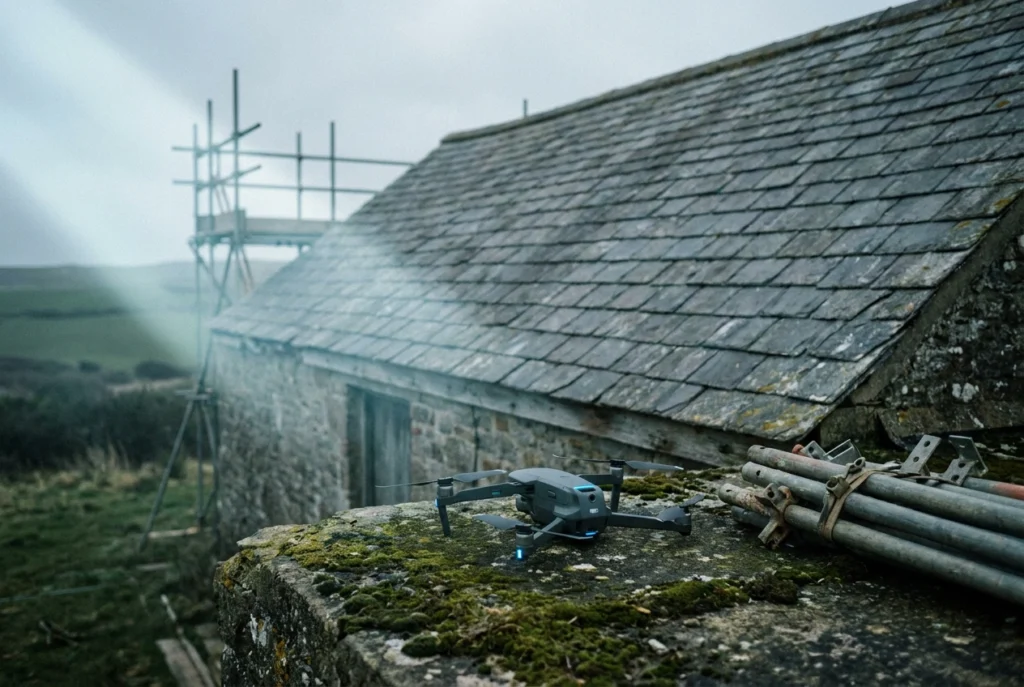
A roof leak rarely announces its cause. Water appears on a ceiling in Bournemouth, a stain spreads in Poole, or a Dorset homeowner notices damp after a storm, and the urgent question is simple: where is the defect? The answer should determine the access method, not the other way around. This comparison examines drone roof survey versus scaffolding on Dorset homes, focusing on what each inspection actually finds. A drone can document flashing, chimneys, gutters, cracked coverings and other visible faults without putting anyone on the roof, often in straightforward cases. It cannot test a covering, look beneath tiles, or replace hands-on investigation when the evidence demands it. Scaffolding remains a genuine option in specific circumstances, but it is not an automatic first step. You will learn why the access method should follow the diagnosis, what a drone survey can and cannot see, what scaffolded inspection adds, whether a drone survey can find a roof leak, when scaffolding is warranted, cost drivers, work at height rules, whether a drone survey replaces a damp survey, what we typically see on Bournemouth, Poole and Dorset roofs, plus answers to common questions. Finding the leak matters more than selling an access method.
Why the Access Method Should Follow the Diagnosis
A ceiling damp patch, stain down a chimney breast or musty upstairs room raises concern: is scaffolding unavoidable? Usually not. Diagnose water ingress first, then match access to the finding, not beforehand.
The Work at Height Regulations 2005 apply wherever a fall could cause injury, requiring dutyholders to avoid work at height where reasonably practicable, such as ground-level inspection with extending equipment. Where height cannot be avoided, the HSE lists cherry pickers and scaffolding as fall-prevention options, so scaffolding is one recognised choice, not the default. Duties can extend to those controlling others’ work, including homeowners, landlords, letting agents and facilities managers commissioning a survey (INDG401).
We stay honest about drone limits and never suggest every leak needs chemical treatment or full scaffolding. Start with What to Do If You Think You Have Penetrating Damp, then read how long penetrating damp takes to dry out.
What a Drone Roof Survey Actually Finds
A drone roof survey gives a close, high-resolution view of external defects that drive penetrating damp. Failed or lifted lead and mortar flashings at abutments, parapets, valley gutters, dormer cheeks and chimney junctions are common entry points. Chimney stacks often show spalling brick, failed flaunching, cracked render, eroded mortar, damaged cowls or lead pulled away from the stack. Gutters may be blocked, sagging or leaking, with overflowing hopper heads and downpipes staining render for months. Coverings can be cracked, slipped, delaminated or missing, with eroded ridge and hip mortar, failed dry-fix systems and perished verge mortar. From above, moss, algae, efflorescence, tide marks and damp staining help pinpoint where rain tracks in.
We capture zoomed stills and video in a single short flight where conditions allow, then annotate the relevant images in a written report. In our typical survey experience, clear external defects such as cracked flashing or blocked gutters are often identified quickly, though this is not a guarantee for every roof. For related questions, see our Frequently Asked Questions.
What a Drone Roof Survey Cannot See
A drone sees surfaces, not beneath. It cannot inspect failed underlay, perished battens, rotted sarking, or damp rafters and ceiling joists; a leak path may only appear once a slate is lifted. Deep valleys, parapet returns, dormer cheeks, flat roof upstands, thatch, louvred vents and dense canopy block sightlines. It cannot distinguish penetrating water, rising damp and condensation, which need different treatments. There are no contact checks: no timber probe, no moisture meter reading in a rafter or chimney breast plaster, no mortar sample, no proof of decay extent. Wind, rain, low cloud and poor light can ground a flight, and restricted airspace around Bournemouth and Poole may require permissions.
Honest conclusion: a drone survey narrows the cause and excludes possibilities quickly, but may show nothing conclusive. Escalation to hands-on inspection, not repeated flights, is then correct. See how damp is detected in the sale process.
What a Scaffolded Roof Inspection Finds That a Drone Cannot
Scaffolding earns its cost through contact. A roofer can probe timbers, battens, felt and sarking by hand, revealing how long water has been entering and how far decay has spread. Coverings can be lifted to trace the exact entry point, which matters when a leak surfaces well away from the defect, a familiar pattern at valleys, abutments and chimney junctions. Lead work, stepped flashings, soakers and mortar fillets can be tested for watertightness and checked for debonding.
Direct moisture readings from rafters, lintels, ceiling joists and chimney breast plaster link an external defect to the internal readings recorded in a damp survey, confirming whether penetrating water is the mechanism. Where a repair is agreed, scaffold access lets it be completed in the same visit.
The HSE treats all fixed roofs as fragile until a competent person confirms otherwise, with fragile surface risks, including old asbestos cement and rooflights, properly managed.
The downsides are real: scaffold costs and hire duration, parking limits, conservation area consent, and Dorset winter weather delays. Scaffolding alone does not diagnose internal damp causes.
Can a Drone Survey Find a Roof Leak?
Yes, often, when the cause is an external visible defect such as cracked flashing, failed chimney flaunching, a blocked gutter or a displaced tile.
EX10 works inside out. A damp assessment with professional moisture meters, and thermal imaging where appropriate, maps where water is showing and how far it has travelled. The drone then flies those specific areas, rather than filming the whole roof and hoping something stands out. Most roof leaks on Dorset homes trace back to a small number of repeated defects, so a targeted survey is often very effective.
Sometimes the answer is no. If nothing conclusive appears, or the defect is concealed, we say so and recommend when to seek professional help rather than re-flying. A ceiling stain traced to a failed mortar fillet at a chimney is one common example, not a guaranteed result.
When Scaffolding Is Genuinely Warranted
Scaffolding earns its cost in specific, recognisable situations:
- A repair is already agreed. Reflaunching a chimney stack, replacing lead flashing or renewing failed ridge mortar needs physical access, not another photograph.
- Defects are widespread. Multiple failures, or coverings that have failed over a large area, make one scaffold lift more efficient than repeated isolated visits.
- Water ingress is confirmed inside but drone footage is inconclusive, because the leak path sits beneath the covering or behind a parapet.
- The roof is fragile or aged. Old coverings, perished battens and fragile rooflights create genuine risk; the HSE treats fragile surfaces as a named hazard.
- Geometry blocks the view, including deep valleys, multiple dormers, mansard profiles or flat roof sections hidden behind upstands.
- A third party asks for it, such as an insurer, mortgage lender or building surveyor requiring a hands-on roof or chimney inspection.
- The building is listed or in a conservation area, where materials and methods need close inspection, common across older Poole, Christchurch and Wimborne homes.
Choosing scaffolding is a legitimate and often correct outcome. A drone survey frequently supplies the evidence that justifies it, showing precisely what needs repairing. Where cracked render accompanies roof defects, it is worth reviewing assessing before you render alongside the roof findings.
Drone Roof Survey Cost vs Scaffolding: What Actually Drives the Price
Having established when scaffolding is genuinely needed, cost becomes the next consideration.
Drone pricing depends on roof size, elevations, height, chimneys, dormers, access and parking, travel across Dorset, and reporting detail. Combining a drone building survey with a full damp survey, moisture readings and thermal imaging changes the scope, but gives internal and external answers in one visit.
Scaffolding drivers are elevations, height, hire duration, erection and dismantling labour, pavement or highway licences, plus weather and access delays.
A drone survey usually costs a fraction of scaffolding for the same initial diagnosis, though we avoid figures because every property differs. EX10 does not publish fixed prices for survey work. Call 01202 790212 or visit www.ex10.com for a proper view.
| Method | Finds | Relative cost | Disruption/access | Lead time | Best use |
|---|---|---|---|---|---|
| Drone | External visible defects | Lower | Minimal | Usually quicker | Initial roof leak detection |
| Scaffolding | Hands-on inspection and repair access | Higher | High | Longer | Confirmed repairs, fragile or concealed defects |
The value is honest: a drone survey either pinpoints the fix quickly or prevents scaffold costs that were never needed.
Work at Height Rules and What They Mean for Property Owners
The Work at Height Regulations 2005 apply wherever a fall could cause injury, so they cover roof surveys and repairs on domestic and commercial property alike. The hierarchy is straightforward: avoid work at height where reasonably practicable, prevent falls where height is unavoidable, and minimise the consequences of any fall that remains possible.
HSE guidance gives ground level inspection using extending equipment as an avoidance example, and cherry pickers or scaffolding as fall prevention options. Notably, HSE does not name drones as a substitute for scaffolding, so treat a drone survey as a diagnostic tool within a sensible access strategy, never as a legal replacement for safe access.
Duties extend to anyone controlling the work of others, so landlords and homeowners commissioning roof work should ask how access will be managed and who is competent. If a drone is quoted, check the operator holds Civil Aviation Authority permissions.
Does a Drone Survey Replace a Damp Survey?
That access hierarchy leaves a diagnostic question. No, a drone survey does not replace a damp survey. A drone sees only the exterior; damp diagnosis requires internal investigation of walls, floors, timbers and ventilation.
Three problems are often confused. Condensation stems from poor ventilation and daily moisture production. Penetrating damp comes from external defects such as roof leaks, failed render or blocked gutters. Rising damp follows a failed or bridged damp proof course. Treatments differ completely, so identifying the right mechanism first prevents paying for work that never addresses the cause.
A damp survey adds calibrated moisture readings at multiple heights, thermal imaging where appropriate to map cold bridging, salt and moisture profiling where rising damp is suspected, and ventilation assessment. Because penetrating damp and roof leak detection overlap, EX10 pairs drone imaging with damp surveying expertise. See our damp survey Bournemouth, rising damp Dorset and mould treatment Christchurch services.
What We Typically See on Bournemouth, Poole and Dorset Roofs
Once the internal moisture picture is clear, the external roof pattern often reflects the era of the property. Central Bournemouth and Poole have many Victorian and Edwardian terraces with natural slate, ageing lead work and chimney stacks untouched for decades. Across Ferndown, Wimborne and New Milton, 1930s and post war homes typically use clay tiles with cement mortar ridges and hips that erode and crack, letting wind driven rain into the roof space. On modern estates, concrete interlocking tiles and dry fix systems mean blocked gutters, failed verge units and poorly detailed abutments are more common than covering failure. Coastal exposure along Bournemouth, Poole and Christchurch pushes rain into flashing, render cracks and chimney junctions; salt and storm damage accelerate wear. We routinely see overflowing gutters staining walls, failed chimney flaunching, debonded mortar fillets, cracked render and internal damp appearing well away from the entry point. This matters to homeowners, landlords, letting agents, property investors, buyers arranging a pre purchase damp inspection and commercial property managers across Bournemouth, Poole, Christchurch, Wimborne, Ferndown, Ringwood, New Milton and surrounding Dorset. Why Choose EX10? explains our survey approach.
Frequently Asked Questions
Can a drone survey find a roof leak? Yes, if externally visible: cracked flashing, failed chimney flaunching, blocked gutters. It narrows the cause quickly.
How much does a drone roof survey cost? Depends on size, height, complexity, access, travel and reporting. Pricing varies; call 01202 790212.
Does a drone replace scaffolding? No, but it often avoids investigation. Scaffolding is needed for hands-on repair, fragile surfaces or concealed defects.
What can a drone not see? Under coverings, failed felt, battens, hidden leak paths, internal moisture. It cannot distinguish rising, penetrating or condensation.
Is a drone survey legal? Flights must be by a competent operator following Civil Aviation Authority rules, including airspace and permissions. Worth asking.
Do I need scaffolding to inspect a chimney? Not always. Drones show failed flaunching, spalling brickwork or debonded lead. Scaffolding is needed for repair.
Can a roof be surveyed in bad weather? Wind, rain and poor light can ground a flight; surveys are booked around suitable conditions.
Is a drone building survey useful for pre-purchase? Valuable for roof and chimney defects, but a full pre-purchase damp inspection should also cover internal moisture readings and ventilation.
Finding the Leak Matters More Than the Access Method
For most roof leak investigations on Dorset homes, a drone roof survey identifies the likely defect quickly, without scaffolding, and as a sensible first step rather than a substitute for diagnosis.
Drones still cannot see beneath coverings, measure internal moisture, or confirm whether damp is rising, penetrating or condensation. Where internal symptoms exist, a damp survey remains essential.
Before booking, note damp patches, stains, musty smells or overflowing gutters, and photograph them; this helps us target the survey.
Whether you need a drone survey, a damp survey, or both in one visit, arrange a professional survey rather than acting on guesswork. Book at www.ex10.com or call 01202 790212 for an appointment across Bournemouth, Poole, Christchurch, Wimborne, Ferndown, Ringwood, New Milton and surrounding Dorset.
Conclusion
A drone roof survey is often the fastest, safest first step for Dorset roof leaks: it can reveal failed flaunching, damaged coverings, and other external defects without scaffolding. But it cannot see beneath coverings, measure internal moisture, or confirm whether damp is rising, penetrating, or condensation. Scaffolding remains essential for hands-on repairs and some detailed inspections, while a damp survey is vital when internal symptoms appear. The right access method should follow the diagnosis, not the other way around.
If you have damp patches, stains, musty smells, or overflowing gutters, photograph them and book a professional survey. Visit www.ex10.com or call 01202 790212 for Bournemouth, Poole, Christchurch, Wimborne, Ferndown, Ringwood, New Milton, and surrounding Dorset. Find the cause first, then choose the safest, most cost-effective route to a lasting repair.