
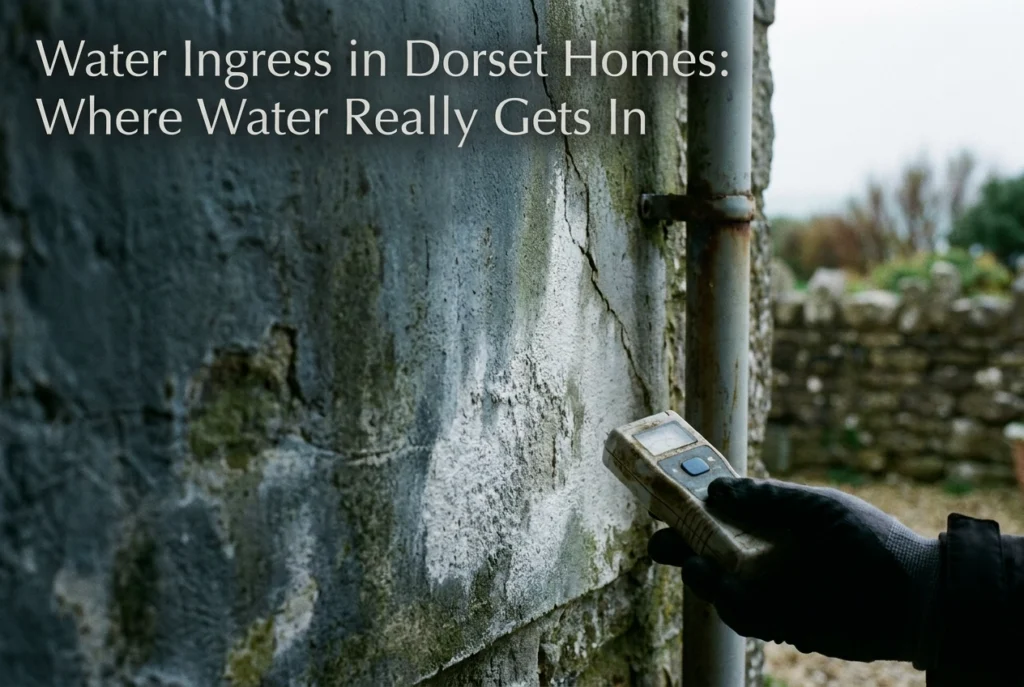
Water marks on a ceiling are not proof that the roof is at fault. A damp patch on an internal wall does not automatically mean the brickwork is failing. In a Dorset home, water ingress is rarely a single, obvious defect. It is the result of water finding a route through the building envelope, often aided by wind-driven rain, old detailing, and the county’s exposed coastal and rural weather. Understanding water ingress starts with plain English: water getting into your home when and where it should not. But the useful question is not simply where you can see the damage. It is where the water actually entered. This guide takes you up the building, from roof coverings, flashings, chimneys and parapets to gutters, downpipes, walls, windows, doors and reveals. You will learn why water ingress is an entry-path problem, not just a wall problem, how to tell rising damp, penetrating damp and condensation apart, and what treatment and maintenance actually stop water long term. By the end, you should be able to diagnose the route before paying to fix the symptom.
What Water Ingress in a Home Actually Means
Water ingress is any uncontrolled movement of water from outside a building to inside it: through a roof covering, a wall, a joint around an opening, or from ground level up. Damp is the symptom you see: tide marks, salts, mould, blistering paint, musty smell. Water ingress is the mechanism delivering the water. Three routes exist: wind-driven rain through the building envelope, ground moisture rising or tracking through the structure, and condensation from moisture generated indoors. These overlap and interact; the BSI/STBA white paper notes driven rain, flooding and condensation are treated separately but in reality overlap and interact. That is why one standard treatment rarely solves everything. Fix the visible stain without locating the route and you pay twice. Our guide to Where Penetrating Damp Usually Appears explains more.
Why Water Ingress Is an Entry-Path Problem, Not a Wall Problem
The most expensive assumption in damp diagnosis is that a stain on a wall means the wall is faulty. So it gets sealed, injected or painted, and water keeps arriving.
Water rarely enters where it shows. It can enter at a chimney, parapet or roof detail and track along a lintel, cavity tray, joist or wall plate before surfacing metres away on an internal wall or ceiling. In older Dorset properties, this is a leading cause of misdiagnosis.
Treating the wrong target hides the symptom while the route stays open, and trapped moisture can worsen the damage. Understanding penetrating damp begins with finding the exact route, then specifying the repair. That sequence makes re-pointing, waterproofing or a window repair permanent rather than cosmetic.
What Dorset Weather and Housing Stock Throw at Your Home
Dorset is hard on buildings. Atlantic and Channel systems arrive on prevailing south-westerly winds as long spells of wind-driven rain, not quick showers, and coast-facing elevations in Bournemouth, Poole, Christchurch and Highcliffe take it square-on. Salt-laden air accelerates mortar, pointing and render decay.
Much of Wimborne, Christchurch and older Bournemouth and Poole is solid-wall construction, where moisture movement differs from modern cavity walls. Retrofits make it worse: added insulation, airtightness, replacement windows and external render slow drying, so the same ingress shows more visibly. Riverside and low-lying ground around Wimborne, Ringwood and New Milton sits on higher water tables, altering how ground moisture behaves at wall bases. Landlords face extra legal weight here: Why This Matters to Dorset Landlords.
Diagnose First: Follow the Water, Not the Stain
Against that backdrop, diagnosis follows a fixed sequence. Work outside-in and top-down: roof covering, chimney, flashings, gutters and downpipes, wall and brickwork, window and door junctions, then ground level and drainage. Approved Document C separates external wall moisture from ground moisture, and a structured damp investigation follows the same order.
Thermal imaging and moisture profiling map where water is and how far it has travelled, not one meter reading on a patch. Where access is awkward, a drone roof survey records coverings, valleys, chimney stacks, flashings and blocked gutters without scaffolding.
Correlate with weather and timing: damp during and after driving rain points to ingress; a permanent low tide mark suggests rising or ground moisture; cold-weather mould on cold surfaces points to condensation. Rule out cheap mimics: slow plumbing leaks, failed shower seals, overflowing tanks and leaking wastes look identical. A professional damp survey or pre-purchase inspection should name the route, evidence it with photos and readings, and specify the repair.
Roof Coverings: Where Unexplained Damp Usually Starts
Roof coverings are the first place to look. Slipped or missing tiles and slates, perished ridge and hip bedding mortar, and porous flat roof coverings on extensions, dormers and porches all let wind-driven rain in. Valley, secret and box gutters often leak while looking sound from ground level. Upstands, parapets and flat-to-wall junctions recur on bungalows and conversions across Ferndown, Wimborne and Ringwood. See Common Places Where Damp Is Often Missed. EX10’s drone roof survey in Bournemouth and roof leak detection in Poole inspect coverings, chimney defects, flashing and blocked gutters without unnecessary scaffolding. The photographic record is inspectable and shareable, useful when briefing a roofing contractor, an insurer, or buyers during a sale.
Flashings, Chimneys and Parapets: The Details That Fail First
Above the roof covering, small details fail first. Lead and mortar flashings at abutments, side walls, chimney steps and dormer cheeks are classic entry points. On chimneys, cracked flaunching, defective pots and terminals, spalling brickwork, failed trays and open flues let driven rain pour straight in. Parapets and copings add movement cracking at junctions and failed joints, sending water behind the wall and into box gutters. A chimney inspection in Dorset can be done from above using drone imagery, showing flaunching, pots and flashing lines clearly without roof access. These are targeted repairs, not structural projects, which is why pinpointing the exact detail before quoting matters. If previous treatments have missed the route, see when damp proofing fails and why.
Gutters, Downpipes and Drainage: Water That Never Leaves
When roof details are sound, check drainage. Blocked or overflowing gutters and downpipes push water into the wall plate, fascia, soffit and eaves, a common cause of upstairs wall damp wrongly blamed on brickwork. Check falls, joint alignment, hopper heads and undersized gutters; many cannot cope with Dorset downpours and overflow at joints onto the wall face.
Watch for wet rot at eaves timbers and joist ends, external staining below the overflow point, and nearby internal damp patches. This is classic penetrating damp.
At ground level, check blocked gullies, cracked drainage runs, pooling against walls, and raised paths, patios or driveways bridging the damp proof course. Approved Document C treats ground moisture separately, to be contained and removed by suitable drainage, not rain-driven ingress.
Walls and Brickwork: How to Stop Water Ingress Through Brickwork
Once gutters and below-ground drainage are ruled out, the wall itself is the most misunderstood part of the building. Water ingress in walls often traces back to porous or spalled brickwork, failed pointing, cracked render, or blown masonry paint trapping moisture behind it.
Cavity walls fail differently: blocked weep holes, bridging debris or insulation, and damaged cavity trays above openings all allow water across. Solid walls offer no cavity to drain or dry, so wind-driven rain passes straight through once pointing and render fail. Older solid-wall buildings behave differently in nature from modern cavity construction.
To stop water ingress through brickwork, work in order: repoint with a compatible mortar, replace spalled units, reinstate cavity trays and weep holes, correct render, then consider a breathable repellent only if genuinely appropriate. Non-breathable sealants or assuming chemical damp proofing will trap moisture and worsen the problem.
Approved Document C’s coverage of solid walls, cavity walls, insulation and cracking gives a useful survey checklist for Dorset properties.
Windows, Doors and Reveals: The Joints the Regulations Single Out
Approved Document C singles out the joint between doors and windows, and door thresholds, which tells you how often these junctions fail. Watch for perished mastic and missing backing rod, absent or badly fitted drip beads, unsealed cavity closers, reveals that hold water, and sills falling the wrong way.
Water then shows internally at the reveal, above the window head where a cavity tray has failed, or at floor level around a threshold or patio door. Replacement windows fitted without correct trays, seals and closers remain a recurring source of new water ingress in older Dorset homes, sometimes years later.
Inspect the external reveal and internal finish together. Blaming brickwork when the fault is a window joint wastes money and leaves the route open.
Rising Damp, Penetrating Damp and Condensation: Telling Them Apart
With window and threshold joints ruled out, name the damp type next.
Rising damp in Dorset homes: ground moisture wicking up the wall, with a low tide mark, white salts, damp skirting and a defective, bridged or missing damp proof course.
Penetrating damp: rain-driven, patchy, worse after wind-driven rain, concentrated on exposed elevations and often higher up or around openings.
Condensation: indoor moisture meeting a cold surface, causing black mould in corners, window reveals and cold junctions. Worst in kitchens, bathrooms, bedrooms and when laundry dries indoors.
Black mould treatment in Christchurch only removes the symptom; it recurs until ventilation, heating and the moisture source are corrected.
Causes overlap, so survey and moisture testing matter. Treating the visible symptom alone means paying twice. Book at www.ex10.com or call 01202 790212.
Water Ingress Treatment: What Actually Stops Water Long Term
Treatment follows the route. That might mean roof covering or lead flashing repair, gutter and downpipe correction, re-pointing, render repair, cavity tray replacement, window and threshold sealing, or drainage and external ground level corrections. Waterproofing and tanking suit basements, cellars and retaining walls where water travels through or below ground; they are not substitutes for a defective roof or flashing repair. Damp proof course solutions and rising damp treatment are appropriate only after testing confirms rising damp. Chemical damp proofing is not the answer to every problem, and default use damages walls and budgets. Where moisture is generated inside, ventilation improvements and condensation control are correct: positive input ventilation, extract fans, trickle vents and targeted dehumidification have a place. After the route is closed, walls dry over weeks or months, and internal re-plastering or redecoration may be needed. Treat instant results with suspicion. Ask your report to name the entry route, the evidence, the specified repair, and a monitoring plan.
Preventing Water Ingress: A Simple Dorset Maintenance Routine
Once the route is closed, keep it closed. A steady routine prevents repeat ingress.
- Clear gutters and check downpipes twice yearly, plus after autumn leaf fall and spring storms, especially on tree-lined streets.
- Inspect roof coverings, flashings, ridge bedding and chimney stacks annually. Where access is difficult or detail unclear, a drone roof survey keeps eyes on the roof without scaffolding.
- Check and renew external mastic around windows, doors, thresholds and service penetrations. Small seal failures are cheap to fix, expensive to ignore.
- Keep ground levels, paths, patios and driveways below the damp proof course, and ensure gullies and drainage run freely away from walls.
- Manage internal moisture: ventilate kitchens and bathrooms, clear trickle vents and air bricks, dry washing outside or in a vented dryer. Treat black mould as a ventilation signal, not a cleaning job.
- Keep a maintenance log with photos. It helps landlords evidence condition and is useful during a sale or pre-purchase damp inspection.
Frequently Asked Questions About Water Ingress
What is the difference between water ingress and damp? Ingress is the mechanism; damp is the result. Fix the route, not the stain.
Does water ingress come through the roof or the wall? Both, and roof entry often shows on a wall, so diagnosis works top-down.
Can wall ingress be fixed without chemical treatment? Often yes: re-pointing, render repair, cavity trays, weep holes, window sealing and drainage fix many cases. Chemical treatment only where rising damp is confirmed.
Do I need scaffolding for a roof leak? Not always. A drone roof survey in Bournemouth inspects coverings, flashings, chimneys and gutters without scaffolding.
Will insurance cover water ingress? Depends on cause, policy wording and how long damage has existed. Dated survey photographs support a claim; outcomes are never guaranteed.
How long to dry out after a repair? Weeks, not days, longer for solid walls. Allow drying time before redecorating.
Which areas does EX10 cover? Bournemouth, Poole, Christchurch, Wimborne, Ferndown, Ringwood, New Milton and surrounding Dorset. Book at www.ex10.com or call 01202 790212.
Fix the Route, Not the Symptom
The FAQs point one way: identify the route before treating the symptom. Water ingress is an entry-path problem, so permanent repairs follow the path, not the stain. Work in order: roof coverings, flashings and chimneys, gutters and drainage, walls and brickwork, then window and door junctions. Test rising damp and condensation as separate possibilities; never assume either.
Not every damp problem needs chemical treatment. The cheapest repair is the one aimed at the right defect.
EX10 provides professional damp surveys, penetrating damp investigations, waterproofing, tanking, damp proof course solutions, ventilation improvements and drone roof and building surveys across Bournemouth, Poole, Christchurch and Dorset. Book a survey at www.ex10.com or call our survey office on 01202 790212 and get the entry route identified before you spend money on repairs.
Conclusion
Water ingress is an entry-path problem, not simply a wall or stain problem. Follow the water through roof coverings, flashings, chimneys, gutters, drainage, brickwork, and window or door junctions before treating symptoms. Rule out rising damp and condensation too, because the cheapest repair is the one aimed at the right defect. A dated, professional survey gives you evidence, direction, and a long-term fix instead of repeated patch-ups.
If damp is puzzling your Dorset home, act before the next storm. EX10 provides damp surveys, penetrating damp investigations, waterproofing, tanking, ventilation improvements, and drone roof surveys across Bournemouth, Poole, Christchurch, and surrounding areas. Book at www.ex10.com or call 01202 790212. Find the route, fix the cause, and protect your home with confidence.