
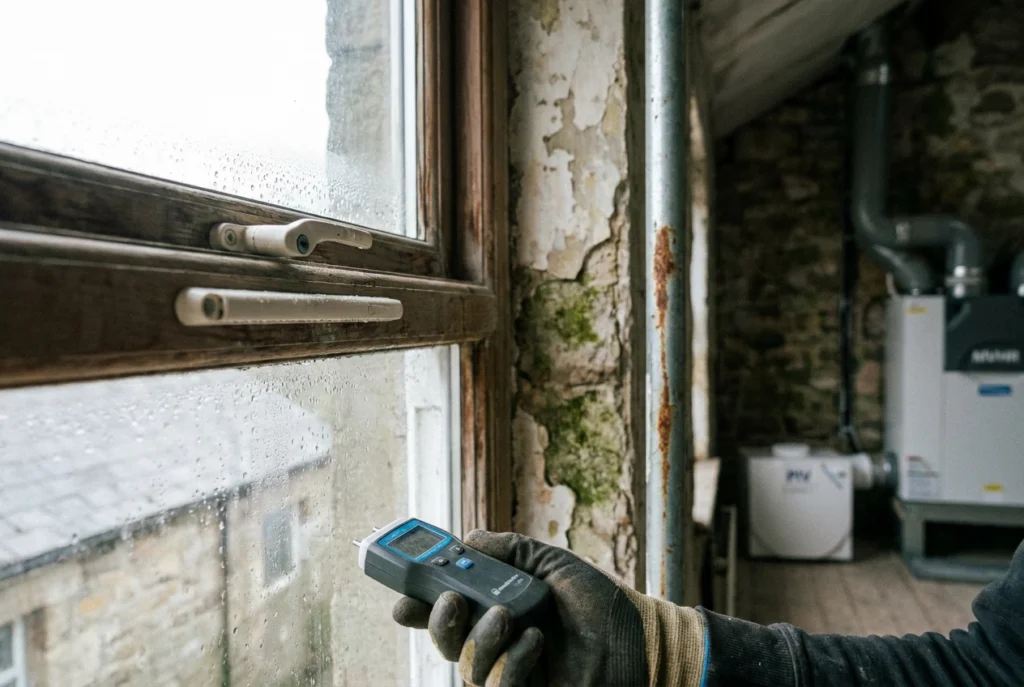
Condensation that keeps returning to the same window, the same corner, the same patch of black mould is rarely a mystery. It usually means the ventilation strategy in your home does not match the way the building actually works. Trickle vents, positive input ventilation (PIV) and mechanical ventilation with heat recovery (MVHR) all manage background airflow, but each suits very different house types and everyday habits. Fit the wrong one and you waste money while the condensation carries on.
This guide sets out the decision criteria rather than promoting a single universal cure. We will explain why condensation keeps coming back in Dorset homes, how trickle vents depend on occupants actually leaving them open, why PIV often suits older, leakier properties, and why MVHR performs best in airtight retrofits. We then compare all three systems, show how to match the fix to your house type, occupancy and airtightness, and flag where condensation control units commonly go wrong. There is also guidance on telling condensation, rising damp and penetrating damp apart before you buy anything, what an EX10 Condensation and Ventilation Survey covers, and how to book one across Bournemouth, Poole, Christchurch and Dorset. Call 01202 790212 or visit www.ex10.com.
Why Condensation Keeps Coming Back in Dorset Homes
Warm, moist air from cooking, bathing, drying clothes and breathing meets a cold surface, a window pane or a north facing bedroom corner, and the vapour turns back into liquid. Repeat it daily and you get streaming windows and black mould.
Modern homes are tighter. FENSA notes that better insulation and improved windows and doors mean homes are no longer naturally ventilated as in past decades, so condensation and mould build up. Approved Document F, England’s statutory ventilation guidance, sets out background ventilation needs and the principle that adequate ventilation prevents excess condensation that can damage a building’s structure.
Condensation is usually an airflow and moisture imbalance, not automatically a damp proofing problem. The fix is ventilation matched to the house, not one universal product. Guess wrong and the condensation stays, your money is gone, and the mould returns next winter. A damp survey in Poole finds the cause first.
Trickle Vents: Background Ventilation That Depends on Habit
Trickle vents create a small permanent opening in a window or door frame so air circulates when closed. They give background ventilation, not a full purge of moist air.
FENSA, a window and door certification body, describes them this way and expects them in most replacement installations in England. Treat that as industry guidance, not statutory wording; they are not required in every case.
They suit homes with baseline air movement, rooms where vents stay open, and occupants who accept a slight draught and winter heat loss. Their limitation: they move far less air than a fan assisted system, handling room by room ventilation rather than a whole house of moisture after four showers.
Checks this week: confirm vents are open, not painted shut, taped over or blocked, and that extract fans run and discharge outside. See How Damp Proofing Works and How to Tell What You Need.
Positive Input Ventilation (PIV): A Better Fit for Older, Leakier Homes
PIV works differently: a loft or wall mounted unit draws in filtered outside air and pushes it gently through the home, creating slight positive pressure that displaces moist air out through gaps and vents.
Because it relies on natural leakage paths, it suits older, leakier Dorset stock: Victorian, Edwardian and interwar homes, plus many 1970s and 1980s properties, rather than sealed new builds.
Airflow is continuous, so unlike trickle vents it does not depend on anyone opening a vent daily, making PIV a realistic whole home air ventilation system for busy households. See Best Practices for Ventilating Your Home.
Trade-offs exist: it can feel cool in winter without a heater, it needs a serviceable location, and loft conversions or flat roofs make installation awkward. PIV will not fix damp from building defects: blocked gutters, failed flashing, defective roof coverings or a bridged damp proof course need investigation and repair.
MVHR: Heat Recovery Ventilation Suits Airtight Retrofits
MVHR sits at the opposite end of that spectrum.
How MVHR works
A mechanical ventilation with heat recovery system extracts moist air from kitchens and bathrooms and supplies fresh air to living spaces, passing both airstreams through a heat exchanger so warmth is retained.
Where MVHR fits
Airtight homes, deep retrofits with new windows, doors and insulation, self builds, and properties with deliberately reduced air leakage. Where uncontrolled leakage remains in older homes, the balanced design is undermined and the system underperforms against its specification.
What installation involves
Ductwork routes, commissioning and airflow balancing, filters that need changing, and a proper design stage. It is rarely a like for like swap after a condensation problem appears.
In a genuinely airtight Dorset home, condensation on cold surfaces is exactly what heat recovery ventilation is designed for. Airtightness and building fabric must be right first.
Trickle Vents vs PIV vs MVHR: Comparing Condensation Control Systems
MVHR only performs as designed once the envelope is sealed. Here is how all three compare.
| System | Mechanism | Suits | Behaviour | Airtightness |
|---|---|---|---|---|
| Trickle vents | Small permanent background opening | Homes with existing air movement | High: useless if left shut | Tolerates leakage |
| PIV | Gentle continuous whole-home air supply | Older, leakier properties | Low | Needs leakage paths |
| MVHR | Balanced extract and supply with heat recovery | Airtight retrofits and new builds | Low, but needs commissioning and filter care | Needs a tight envelope |
All three share one limitation: none repairs water ingress, rising damp or defective plumbing, and none should be chosen before the moisture source has been identified. If mould keeps returning, ventilation may be the wrong starting point; our guide to why mould grows in Dorset homes separates condensation from other damp types.
How to Choose: Matching the Ventilation Fix to Your House Type
Start with three questions: how old and leaky is the property, how many occupants and how much moisture do they produce, and what has already been done to windows, doors and insulation?
Older Dorset homes with original or part-upgraded windows and no recent airtightness work usually suit background ventilation plus targeted extract, or PIV. After replacement windows and doors, keep fitted trickle vents open and working; the new units reduce the air movement old frames allowed. In recently insulated deep retrofits with new glazing and draught proofing, heat recovery ventilation is worth discussing at design stage, alongside an airtightness strategy.
Survey first. A north-facing Victorian terrace in Wimborne rarely needs the same system as a sealed dormer bungalow in Ferndown, and the logic holds across Bournemouth, Poole, Christchurch, Ringwood and New Milton. Landlords can read more in our Damp and Mould in Dorset Rentals guide.
Choosing by Occupancy and Everyday Behaviour
Occupancy drives moisture load more than floor area does. Count the showers, cooking, indoor clothes drying, tumble dryers vented indoors, aquariums and the number of people living in the home. In busy households where nobody opens a vent, systems that work regardless of habit, such as PIV or a properly commissioned MVHR, are usually more dependable than trickle vents alone. Smaller households with established good habits may find background ventilation plus well functioning extract fans entirely sufficient, provided the vents are genuinely used. In rental properties, HMOs and managed lets, behaviour-independent systems are often the better long term choice, and landlords benefit from documenting the ventilation strategy. In our condensation surveys across Dorset, drying washing indoors with the door shut is one of the most common contributors we see, and it changes the specification more than people expect. If you are unsure whether those marks are black mould, mildew or condensation, identify them before spending money.
Choosing by Airtightness and Retrofit Work
Occupancy is only half the picture; the building itself sets the ceiling. Airtightness is how much uncontrolled air leakage a building has. The tighter the property, the more deliberate ventilation it needs, because the accidental draughts that once did the job have been sealed off.
In leaky older homes, that excess air movement makes balanced heat recovery harder to justify; continuous supply ventilation is often the more sensible first move. Recent retrofit work flips this: new windows, doors, insulation and draught proofing cut leakage, so background ventilation and mechanical extract matter more than ever.
Mixed states are normal locally: modern glazing at the front, original sashes at the back, so a room by room assessment beats a blanket recommendation from an independent damp survey in Dorset.
The classic oversight? Improving airtightness without adding ventilation predictably brings streaming windows, cold corner mould and musty mornings.
Where Condensation Control Units Go Wrong and Waste Money
Specification alone is not enough. The costliest error is buying a condensation control unit before diagnosing the cause: moisture from a leaking gutter, defective flashing or a bridged damp proof course keeps arriving regardless of airflow.
Trickle vents fitted then left closed, taped over or hidden behind curtains return the home to its pre-ventilation state within a season. PIV installed with no usable loft, no sensible unit position or no servicing and filter plan is money spent on a system nobody maintains. MVHR specified in a non-airtight property often ends up noisy, unbalanced or ineffective, and the technology is blamed rather than the specification.
Extract fans are ignored too often. A blocked, undersized or loft-ducted bathroom or kitchen fan just moves moisture around the building fabric instead of outdoors. More traps appear in our guide to common mistakes and how to avoid them.
Condensation, Rising Damp or Penetrating Damp: Diagnose Before You Buy
Diagnose the type before buying anything. Condensation shows as streaming windows, black spot mould on cold external walls and corners, and musty smells that worsen in the morning and through winter. Rising damp leaves low tide-mark staining on ground floor walls, with salts and blistering plaster near the skirting where a damp proof course is missing or has been bridged. Penetrating damp appears as patches that grow after wind-driven rain, often staining chimney breasts, window reveals, roof valleys, parapets or gutters.
EX10 identifies the underlying cause rather than covering up symptoms, using professional moisture meters, thermal imaging where appropriate and drone roof and building surveys to check coverings, flashing, chimneys and gutters without unnecessary scaffolding. A chemical damp proof course is not the answer to every damp problem, and condensation is normally resolved through ventilation, moisture control and behaviour rather than injection. Diagnosis first, then the right remedy.
What an EX10 Condensation and Ventilation Survey Covers
That process begins with a home visit. A surveyor takes moisture readings across walls and window surfaces, maps mould patterns and reads the room layout to establish where moist air is produced and where it becomes trapped.
They then inspect the existing ventilation: trickle vents, extract fans, ducting and any condensation control equipment already fitted, confirming what is working, blocked, painted shut or undersized.
Where appropriate, thermal imaging highlights cold surfaces and hidden air leakage, while a drone roof survey rules out external water ingress from defective roof coverings, flashing, chimney defects or blocked gutters.
You receive a written assessment separating condensation, rising damp and penetrating damp, with recommended ventilation improvements and any damp proofing or waterproofing genuinely required.
The service covers homeowners, landlords, letting agents, property investors and commercial clients across Bournemouth, Poole, Christchurch, Wimborne, Ferndown, Ringwood, New Milton and surrounding Dorset.
Frequently Asked Questions
Questions we commonly hear:
Do trickle vents stop condensation on their own? They provide background ventilation, not a complete fix. They only work when open, clear and paired with running extract fans.
Is PIV or MVHR better for an old house? Usually PIV. Older homes leak air naturally and need those paths; MVHR suits airtight envelopes.
Do I need a condensation control system if I already have extract fans? Only if they run long enough, are powerful enough and discharge outdoors. Otherwise, moisture volume or a second damp source is likely.
How do I know if it is condensation or rising damp? Pattern and height. Cold-surface mould and streaming windows suggest condensation; low-level staining, salts and plaster damage suggest rising damp. A survey confirms which.
Can I just leave a window open instead? It purges moisture fast but needs someone present. Mechanical ventilation is steadier.
What should I ask an installer before agreeing to work? Ask what is being fitted and why, who commissions and services it, and what happens if condensation returns. Be sceptical of blanket guarantees.
Next Steps: Book a Ventilation and Condensation Survey
Before choosing any system, get the diagnosis right. Trickle vents, PIV and MVHR solve the same problem differently, and the right choice depends on the home’s age, airtightness, number of occupants and daily habits. Condensation, rising damp and penetrating damp need different solutions, so treating one as another wastes money and time. Take easy wins now: keep trickle vents open, run extract fans for longer, dry washing outdoors or in a vented space, and clear blocked gutters and downpipes before winter. If mould or damp keeps returning, arrange a professional survey with EX10 at www.ex10.com or call 01202 790212. Where external water ingress is suspected, ask about drone roof and building surveys to check roof leaks, damaged coverings, chimney defects, blocked gutters and defective flashing without unnecessary scaffolding.
Conclusion
There is no single fix for every Dorset home. Trickle vents, PIV and MVHR all manage moisture differently, and the right choice depends on your property’s age, airtightness, occupancy and daily habits. Good ventilation habits help, but they are not a substitute for correct diagnosis. Condensation, rising damp and penetrating damp need different solutions, so identifying the cause first saves money and avoids repeat mould. If damp keeps returning, book a professional ventilation and condensation survey with EX10 at www.ex10.com or call 01202 790212. Where external water ingress is suspected, ask about drone roof and building surveys. Take the next step today, get clear answers, and protect your home with the right solution.