
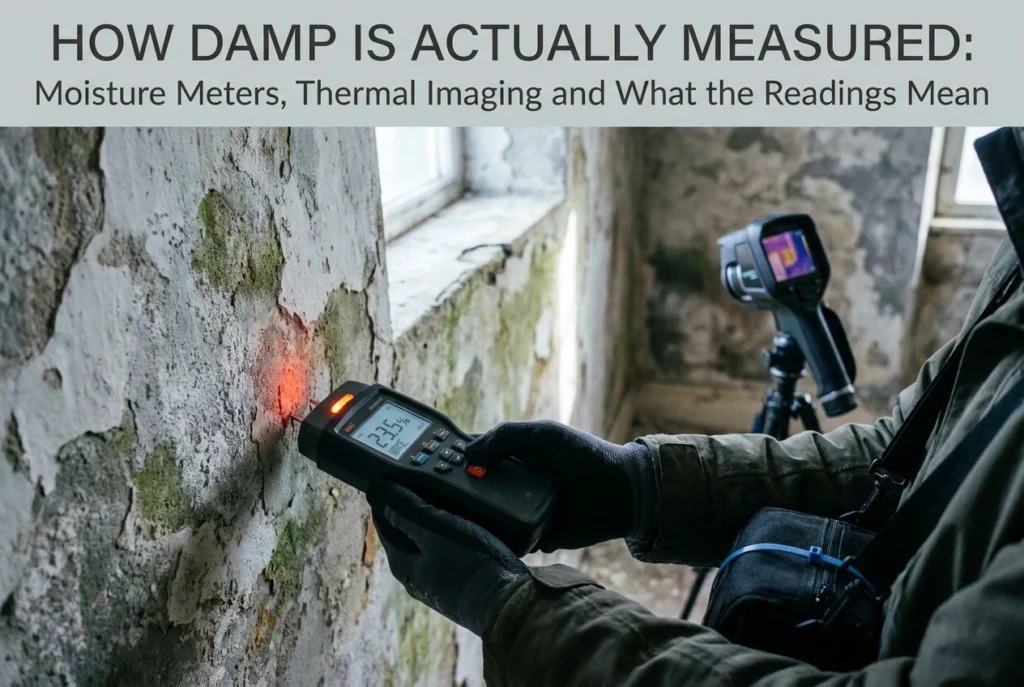
A moisture number can look persuasive in a survey report, but on its own it proves very little. Moisture testing becomes evidence only when you know which instrument took the reading, where it was taken, and what baseline it was compared against. A pin or pinless meter, thermal imaging camera, salt test, gravimetric test or carbide test each answers a different question. None can identify the cause of damp by itself, so a sound diagnosis must consider rainwater, indoor air and ground water before any treatment is recommended.
At EX10, a damp proofing, damp surveying and drone inspection specialist serving Bournemouth, Poole, Christchurch and Dorset, we believe method transparency matters. This guide explains why a moisture number cannot reveal its own cause, how pin and pinless meters differ, what thermal imaging can and cannot show, and how salt, gravimetric and carbide testing compare. You will learn how to interrogate any damp survey report, including ours, what external inspection adds, why coastal Dorset conditions affect readings, and common questions about moisture testing before you book a survey. To discuss evidence-led moisture testing and a damp survey, visit www.ex10.com or call 01202 790212.
Why a Moisture Number Cannot Identify the Cause of Damp
A moisture content test result tells you water is present, not where it came from. The Property Care Association’s guidance on moisture meters (July 2020; check for a newer edition) states that meters and similar methods cannot differentiate between one source of dampness and another. That is why a reading alone is never a diagnosis.
In most buildings, dampness comes from three sources: rainwater penetrating the fabric, water from indoor air (condensation), or water from the ground. Each needs a different fix, so misidentifying the source wastes time and money. Condensation is frequently misread as rising damp. Establishing the wall moisture profile, how readings change with height and depth, is how the two are separated.
All potential causes must be considered before arriving at a conclusion. A thorough damp survey therefore examines the whole building, inside and out, rather than treating one high reading as proof. Diagnosing the Source of Damp explains how this investigation works.
Pin and Pinless Moisture Meters: Two Tools, Two Different Jobs
Having established that a number alone cannot name the cause, the next question is which instrument produced it.
Pin meters
Probes driven into the wall or timber measure electrical conductivity between the pins, so a reading applies to that exact point and depth. You get precision, but only where you have already decided to look.
Pinless (capacitance) meters
Pressed flat against a surface, these respond to changes in the material beneath. That makes them quick for scanning a large area, and suitable for tiles or finished plaster you would rather not puncture.
Both are electrical methods, and both react to more than water content. An electrical reading is an indication rather than a direct measurement, because background salts, surface contamination, plaster additives and metal fixings nearby can all push the figure up or down.
In practice, pinless scanning finds where to look; pin readings then confirm at a specific depth. That is why a credible report lists locations and depths rather than one headline number. Our guide to the Tools Surveyors Use to Detect Damp in Walls shows how this works on site.
The DIY trap is buying a cheap meter and treating a single high reading as proof of rising damp. Calibration varies between meters, so readings are best compared against a dry baseline in the same property.
What a Thermal Imaging Camera Can and Cannot Show
Where pin and pinless meters give a number at a point, thermal imaging gives a picture. In professional use, it detects surface temperature patterns rather than moisture content directly. What you see is a pattern in the infrared image, not a measurement of water content.
That pattern is useful for finding the shape of a problem: cooler bands that suggest evaporation, cold bridging, damp patches hidden under finishes, or water tracking across a ceiling. Conditions matter. In practice, results are more interpretable when there is a meaningful temperature differential between inside and outside, and warm objects, solar gain, cavity insulation and other heat sources near the survey area can affect the thermal pattern and need to be accounted for.
In professional use, thermal imaging alone cannot tell condensation from penetrating damp or rising damp, nor directly measure how wet a material is. That combination of thermal imaging with meters, salt tests and a close look at the building fabric is how EX10 uses it on damp surveys in Bournemouth and Poole, alongside diagnosing penetrating damp accurately.
Salt Tests, Gravimetric Testing and Carbide Testing Compared
Where thermal imaging identifies a pattern, sample-based tests answer harder questions about what is actually inside the wall. Sample-based testing confirms what thermal imaging and electrical meters can only indicate.
Salt analysis: Plaster samples are tested analytically to confirm hygroscopic salts. These matter because rising damp is accompanied by salt problems, and their presence can persist in the wall fabric and continue to affect electrical meter readings.
Gravimetric testing: Drilled samples are oven dried in a laboratory to establish true moisture content by weight. This laboratory method provides a reliable moisture figure that field meters can be compared against.
Carbide testing: Carbide testing uses a chemical reaction between a wall sample and calcium carbide to give an on-site moisture estimate; it is quicker than laboratory methods but still sample-based and requires interpretation.
When to pay for each: Gravimetric and salt tests are worth commissioning where diagnosis is genuinely contested, or where a dispute, insurance claim or purchase hangs on the result. For routine moisture testing and progress checks, field meters are usually sufficient.
Building knowledge remains indispensable, the same figure can mean different things in a solid-walled terrace and a modern insulated home.
How to Interrogate a Damp Survey Report
Treat any reading as evidence only if it answers four questions: which instrument took it, exactly where on the wall, at what depth or surface, and against what baseline. A number without those four details cannot be checked, so ask for them. You will find these questions reflected in EX10’s survey approach and in the booking checklist below.
Then look for a described moisture profile rather than a single figure. Rising damp typically shows a moisture gradient ascending from floor level, though an electrical moisture meter may not always show this pattern cleanly, so an absent gradient does not automatically rule it out.
Check whether the report separates surface and deep readings, and whether high readings sat near salts, skirtings, fixings or recently replastered areas, all of which can skew results. A reading at 150 mm and one at 1 m mean different things.
Expect the diagnosis to name the mechanism and route of water entry, not just label the damp type. Be wary of a report that jumps to a treatment recommendation with no investigation notes, since sound investigation should follow a recorded methodology such as the PCA’s damp investigation guidance.
A survey from EX10 is designed to document method alongside measurement, so a landlord, buyer or letting agent can check the reasoning rather than take it on trust. Where rising damp is claimed, weigh the evidence against rising damp treatment explained for Dorset homeowners before accepting any treatment plan.
External Inspection: The Evidence a Meter Cannot Give You
A credible report also looks beyond the wall it measured. A thorough investigation should also look at the external fabric for likely defects such as rainwater goods, throating to windowsills, roof coverings, pointing and render, the internal reading alone cannot confirm the entry point.
Internal readings can be perfectly accurate yet miss the cause, which may sit outside on a slipped slate, a cracked render band or a leaking gutter discharging onto the wall.
That is where drone roof and building surveys help. EX10 uses them to inspect roof coverings, chimney stacks and flashing, blocked gutters and valleys without unnecessary scaffolding. This is valuable for hard-to-access Dorset property types, from steep-roofed Victorian terraces in Wimborne to bungalows in Ferndown and New Milton.
The best evidence combines instrument readings with direct observation of the building. It is why roof leak detection in Poole and chimney inspections across Dorset form part of many EX10 damp investigations, and why an accurate number can still lead to the wrong conclusion until the outside is checked. To understand how this investigation shapes what a damp survey costs in Bournemouth and Dorset, see our guide.
Coastal Dorset: Why Local Conditions Change the Reading
Direct observation of the building explains a great deal, but the setting explains the reading itself.
Coastal locations like Bournemouth, Poole and Christchurch are exposed to wind-driven salt air, which can raise the background salt load in wall materials over time. Because electrical moisture meters are sensitive to dissolved salts as well as water, an elevated reading in coastal masonry may not always indicate active water ingress, it needs to be interpreted in context.
Exposed coastal facades also take the brunt of wind-driven rain, making penetrating damp through defective pointing, cracked render or overflowing rainwater goods a common finding. The route water takes is often external, which is why Water Ingress in Dorset Homes: Where Water Really Gets In is worth reading alongside any survey.
Condensation risk shifts with how a property is used. In flats and rental properties, occupancy levels, heating patterns and ventilation habits change the balance between moisture produced indoors and moisture removed. A tenanted flat with intermittent heating and poor extraction behaves differently from an owner-occupied house.
This is where local experience counts. The same instrument reading in a Christchurch bungalow and an inland property can carry a different meaning, and EX10’s surveyors interpret each result against the building and the coast it sits in.
Frequently Asked Questions About Moisture Testing
Local salt load is one reason readings vary, and it leads to the questions buyers ask most.
Is a pinless moisture meter as accurate as a pin meter? Pinless (capacitance) meters scan for moisture across a larger surface area without penetrating it; pin meters use electrical conductivity between two probes driven into the material at a specific point. Neither is inherently more accurate. Both need interpretation.
What is the best moisture meter for a UK home? No single best. The right tool depends on the question, surface and building. Professional surveys use several methods together, as explained in how a rising damp specialist finds the real cause in Dorset.
Can a moisture content test prove rising damp? No. Salts, contamination, cold bridging and condensation all influence readings. Proof comes from the moisture profile and salt analysis, not one number.
Do I need thermal imaging if a meter already shows high readings? Not always. It helps map the extent and pattern of damp without opening walls, useful before invasive work.
Will my survey report show the readings? A proper report lists the instrument, where readings were taken and the baseline used. If missing, ask for it.
Book a Damp Survey That Shows You the Evidence
Armed with those questions, the next step is practical.
A reading is only evidence when you know the method, the exact location and the baseline it was compared against. A professional damp survey should give you all three, in writing, so you or your adviser can check the reasoning.
Before booking, gather any existing report and apply the four questions to every number: which instrument, where on the wall, at what depth or surface, and compared with what. Then arrange an investigation that covers the building inside and out, because internal readings alone can miss a slipped slate, leaking gutter or failed render.
Across Bournemouth, Poole, Christchurch, Wimborne, Ferndown, Ringwood, New Milton and wider Dorset, EX10 provides damp surveys that document method alongside measurement. Call 01202 790212 or book at www.ex10.com.
EX10 diagnoses the underlying cause rather than covering up symptoms, using professional moisture meters, thermal imaging where appropriate and drone surveys of the roof to inspect hard-to-access areas. If you want evidence you can interrogate, not just a number you have to trust, start there.
Conclusion
A reading without method, location and baseline is not yet evidence, that principle runs through every section above. Thermal imaging, salt tests, carbide testing and gravimetric testing each answer different questions, so a credible investigation combines them with an external inspection of roof, gutters, render and rainwater goods, because internal numbers alone can miss water entering from outside.
That is the evidence EX10 aims to provide across Bournemouth, Poole, Christchurch, Wimborne, Ferndown, Ringwood, New Milton and wider Dorset, documenting method alongside measurement. Call 01202 790212 or book at www.ex10.com.