
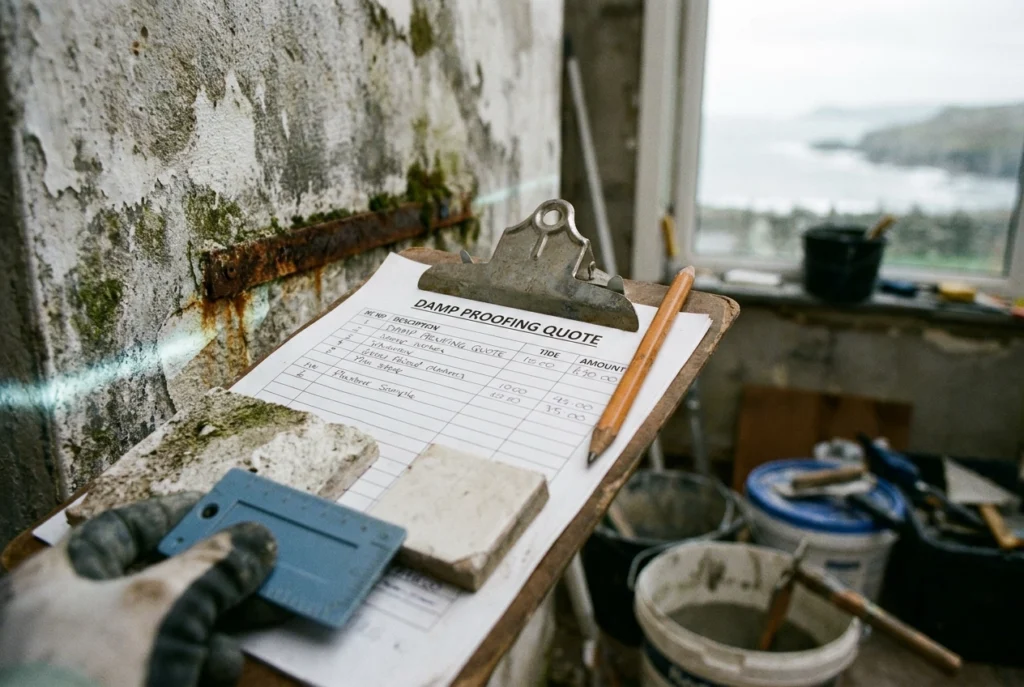
A damp proofing quote can look thorough and still miss the line that decides whether the repair lasts. Comparing totals tells you little if the specification skips the plaster stage, because damp and salt contamination are not solved by a damp proof course alone. The real test is whether the quote explains the damp proofing materials for walls it intends to use, including plaster type, salt neutralisation, depth of removal and realistic drying allowances.
This guide explains why the total price is the least useful line on a quote, what damp proofing materials for walls should mean, and how to read the five key lines for internal walls in order. It also covers non-plaster products such as DPCs, tanking and membranes, the importance of cause before cure, relevant standards, and extra caution for traditional, listed and pre-1919 properties. You will finish with clear questions to ask and a practical method for comparing damp proofing quotes properly.
EX10 is a damp proofing, damp surveying and drone inspection specialist serving Bournemouth, Poole, Christchurch and Dorset. To book a survey, visit www.ex10.com or call 01202 790212.
Why the total price is the least useful line on the quote
Two quotes can show a similar headline figure and describe completely different jobs. The total never says what happens to the wall after treatment.
What is left behind once treatment ends largely decides whether the wall recovers. A damp proof course or membrane without the correct plaster build-up leaves salts and residual moisture to spoil the new finish.
The specification shows whether the contractor has understood the building, the confirmed cause and the salt risk, or simply priced a treatment; how damp proofing works depends on that understanding. A surveyor’s survey should comply with BS 7913, BS 5250 and BS 6576, and follow the RICS Joint Position Statement on investigating damp in traditional buildings, as Cotswold District Council recommends.
Read the specification before the total. Compare plaster type, removal depth and drying allowance, not pound signs.
What damp proofing materials for walls should mean in a quote
Online, “damp proofing materials for walls” means very little. In a quote it should break down into surface preparation, any damp proof course, tanking or membrane, the salt stage, the backing coats and the finishing plaster. Ask for that build-up in layers, from masonry outwards, with a named product for each stage and the order it is applied in.
Materials should suit the wall, not a price band: dense cement-based renders behave very differently from breathable lime-based plasters in older, solid masonry. Be wary of vague lines such as “render and skim” or “plaster to affected areas” with no product names, thicknesses, heights or coverage stated in writing.
Our damp proofing guide for Dorset homeowners shows how a specification is built from diagnosis rather than a template.
Damp proofing internal walls: read these five lines in order
Five lines decide whether the finish survives: plaster type and breathability, salt neutralisation, depth of removal, backing coats, and drying allowances. Read them in that order, because each depends on the last. A good backing coat is wasted if salt treatment is missing, and salt treatment is wasted if contaminated plaster was merely skimmed over.
Annotate both quotes side by side. Where a quote is silent on any line, ask the contractor in writing what happens at that stage before deciding anything. Our step-by-step guide to damp proofing a wall yourself shows how each layer is built.
Line one: plaster type, breathability and lime versus cement
Line one is the plaster system. Ask for it by name and the reason it suits your wall. Cement-based, lime-based and specialist renovating plasters behave and dry differently. Cement render can accelerate decay in old buildings, so breathability matters: moisture and vapour need a route out, or a dense finish traps it in the masonry.
Pre-1919 buildings were typically built with breathable lime-based plasters, and Cotswold District Council advises against cement plaster or render in traditional buildings. See choosing the right type of render.
Ask whether the specification has allowed for nearby wall insulation, since Historic England warns that insulating masonry walls can worsen existing moisture problems or create new ones. If the quote simply says “plaster” with no system named, put that question in writing first.
Line two: salt neutralisation and the wording that proves it
Even the correct plaster will fail if salts remain in the masonry. Long-term damp and rising damp draw soluble salts into plaster, so a repaired wall can look sound but still fail at the surface. Rising Damp Treatment Explained for Dorset Homeowners explains how rising damp differs from penetrating damp and condensation.
A specification that takes salts seriously names a salt-neutralising or salt-retardant coat, or a poultice stage, and states where it sits in the layer sequence. Ask:
- which product is used;
- whether it goes on before the backing coat;
- what it should achieve on your wall.
Be wary of “two-coat plaster to affected areas” with no salt provision, especially on a long-damp wall. Request the salt stage and the pre-finish moisture check in writing.
Line three: depth of removal and where the old plaster stops
Salt treatment only works if contaminated plaster is removed first. Damp, salt-laden plaster is unlikely to perform as a stable substrate, so your quote must state how much is taken off, not skim over damaged material.
Look for a stated removal height and depth, and note the reference point: floor level, skirting line or the identified damp source. Confirm whether removal stops at a decorative line or continues to a height set by the survey, and get that figure written into the quote.
Ask how edges are handled where removed plaster meets sound plaster, and how exposed masonry is prepared before rebuilding. In practice, a lower-cost quote sometimes covers less removal, and that is where salt staining tends to return. Verify the extent against the findings of a damp survey in Poole before signing.
Line four: backing coats and the full plaster sequence
Once removal depths are agreed, the next line is the build-up itself. Backing coats carry the structural and moisture work before the finish plaster. Insist the quote states the number of coats, thickness of each, drying time between them and product names, in writing. Check any renovation, salt-neutralising or moisture-tolerant coat sits in the correct position in the sequence, not tagged on later. Confirm how the system meets the skirting, floor and any existing DPC, membrane or tanking, leaving no gap or cold bridge. If it says only “render and skim”, request a layer-by-layer specification before comparing quotes. For the final readiness check, see How to Tell When the Wall Is Fully Dry.
Line five: drying allowances and the programme of works
A sequenced backing coat means little if the programme rushes the finish. Plaster must dry before decoration, so a quote that schedules painting or skimming immediately after treatment deserves challenge.
Ask the contractor to state the drying period in writing, based on the product data sheet and your wall’s condition, not habit. Check what happens between plastering and decoration: ventilation, heating, moisture readings, and who confirms the wall is ready. Cold weather, occupancy and poor ventilation all slow drying.
If the timescale looks compressed, ask what has been shortened; it is often the drying allowance. A Damp Treatment Specialist in Bournemouth, Poole and Dorset can review this line before you compare totals.
Wall damp proofing products that are not plaster: DPC, tanking and membranes
Plaster sits on top of other products, so read these lines together: injected damp proof courses, membranes, tanking, renders and waterproof paints all turn up in quotes.
Cotswold District Council advises that in traditional buildings, injected damp proof courses, cement render and waterproofing such as tanking or paints are unlikely to solve the problem and may make it worse. Where a barrier product is specified, the quote should explain why it suits this wall and this confirmed cause, not treat it as default practice.
Condensation, penetrating damp and rising damp need different solutions; not every wall needs a chemical damp proof course. Ask which problem is being treated, whether the product conflicts with how the wall dries or breathes, and whether Listed Building Consent is required.
Cause before cure: the section no quote should skip
Whichever products the quote lists, none will perform if the cause has not been identified. Cotswold District Council names blocked or damaged rainwater goods, damaged pipework, slipped slates, blocked ventilation bricks, high water tables and raised ground levels as common causes. SPAB adds that damp is frequently misdiagnosed and unnecessary treatments, including membranes, often follow.
So check for an investigation record: where moisture readings were taken, what they showed, and what was ruled out. Where access is difficult, chimney, flashing and gutter defects still need checking; EX10 uses drone roof and building surveys across Bournemouth, Poole, Christchurch and wider Dorset to inspect these without unnecessary scaffolding.
If the only fix offered is a treatment rather than a cause, treat that quote as incomplete.
Standards a serious specification should be able to reference
A well-grounded specification should be able to say which of the relevant standards, BS 7913, BS 5250, BS 6576 and the RICS Joint Position Statement, apply to your building and cause, and why.
For traditional or listed properties, confirm whether Listed Building Consent is needed before work begins, as Cotswold District Council notes.
Then ask for the surveyor’s reasoning in writing: what was found, what it means for the wall, and why this specification is the appropriate response. A quote that cannot say what it is based on is far harder to hold to account if the damp returns. Next, check how the spec treats older fabric.
Traditional, listed and pre-1919 properties: extra caution with the spec
For pre-1919 buildings, the specification needs still closer reading. SPAB notes these walls were typically built from breathable materials and mostly without damp-proof courses or membranes, so dense modern systems can trap moisture rather than control it. Cotswold District Council’s advice against injected DPCs, cement render and waterproofing paints in traditional buildings applies here with even greater force. Historic England warns that wall insulation can worsen existing moisture problems or create new ones, which matters if retrofit is planned alongside the damp work. Listed Building Consent may be required before carrying out damp works on a listed building, so confirm this with your local authority before accepting a quote. Ask the contractor how the specification respects the wall’s breathability, and whether they have worked on buildings of similar age and construction.
What to look for versus what should raise questions
Carry those checks into a simple pass, question or fail mark against each quote.
| Checkpoint | Pass | Question | Fail |
|---|---|---|---|
| Plaster system | Named product and reason | Reason unstated | “Render and skim,” no product |
| Salts | Salt-neutralising stage for a long-damp wall | Method unspecified | No mention of salts |
| Removal | Height, depth and join to sound plaster stated | Height or depth missing | “Plaster to affected areas” |
| Backing coats | Products, thicknesses, drying between coats | Products or thicknesses missing | Finish plaster only |
| Drying and cause | Drying allowance, readiness check, recorded cause | Cause stated, drying unchecked | Decoration immediate, treatment only |
Mark each row, then put every outstanding question in writing before comparing totals. A quote failing two or more rows is not cheaper; it is unfinished.
FAQs on comparing damp proofing quotes
Does every damp wall need a chemical DPC? No. Condensation, penetrating damp and rising damp need different solutions; injection suits confirmed rising damp only.
What is salt-neutralising render, and is it needed? It resists salt migration into new plaster. On long-damp walls, ask which product is used and where in the sequence.
How long should plaster dry before decorating? No single figure fits every wall. Ask for the period in writing, based on product and wall, and how readiness is checked.
My quote omits plaster removal. What should I do? Ask what happens to contaminated plaster, to what height and depth, and get it added before signing.
Can I compare quotes on price alone? No. Read the plastering specification first; price means little until you know what each quote includes.
Comparing damp proofing quotes properly
Work through both quotes side by side. Compare five lines only: plaster type, salt neutralisation, depth of removal, backing coat sequence and drying allowance. Where a line is missing or vague, ask for it in writing before you decide. A contractor who cannot explain their own specification has not finished the job on paper.
If neither quote names the cause, or both treat every wall identically, arrange an independent damp survey first. EX10 carries out damp surveys and pre-purchase damp inspections across Bournemouth, Poole, Christchurch, Wimborne, Ferndown, Ringwood, New Milton and surrounding Dorset, using moisture testing, thermal imaging where appropriate and drone roof surveys to find the cause before treatment is recommended.
Book at www.ex10.com or call 01202 790212 to talk through your quotes and what the specification should include.
Conclusion
A damp proofing quote is only useful once the plastering specification is clear. Compare five lines: plaster type, salt neutralisation, depth of removal, backing coats and drying allowances. If any line is vague or missing, ask for it in writing before you sign. Most importantly, confirm the cause has been properly identified before any treatment is agreed.
Get the cause right first, and the rest of the work becomes far easier to compare and control.