
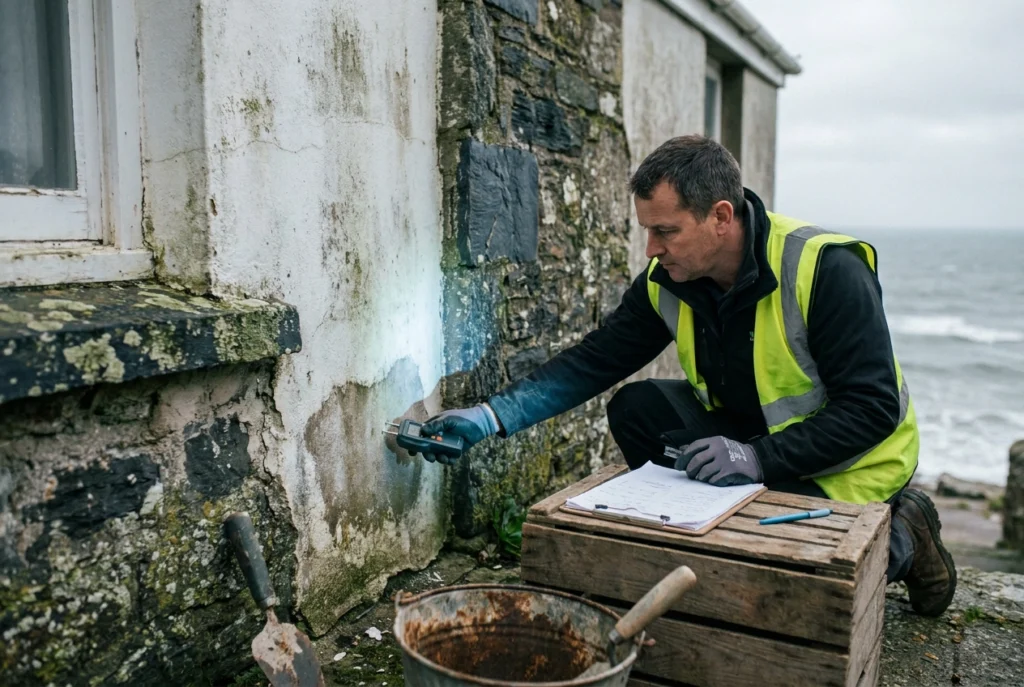
If you have ever received two rising damp quotes for the same property and wondered why they differ by thousands of pounds, you are not alone. Across Bournemouth, Poole, Christchurch and the wider Dorset area, the gap between the cheapest and most expensive quote rarely comes down to the cost of the injection itself. It usually reflects what sits around it: the survey, plaster reinstatement, skirting, making good and guarantees.
This analysis unpacks what a legitimate rising damp treatment price is actually made of, so you can compare damp proofing solutions fairly rather than judging on headline figures alone. We begin with why the injection is seldom the biggest line on a quote, then look at why damp is a symptom rather than a diagnosis and what RICS says about misdiagnosis and the rarity of original damp-proof course failure.
From there, we break down what a proper damp survey should include, examine legitimate cost variations, and flag charges that should not appear on your quote at all. We also separate rising damp, penetrating damp and condensation before covering external causes such as roof leaks, gutters and chimneys, how to compare quotes in Dorset, and the questions to ask before you accept any price.
Why the Injection Is Rarely the Most Expensive Part
A chemical damp proof course injection is a small, standardised element. Materials and labour are broadly the same from wall to wall, so injection rates explain little of the gap between two quotes for the same job.
Scope moves the price. How much salt-contaminated plaster must be removed and replaced, whether skirting is lifted and refitted, how much making good and decoration is included, how hard the wall is to reach, and what guarantee is attached.
Two quotes can describe identical work in entirely different ways. One covers diagnosis, reinstatement, waste removal and a written guarantee. The other covers drilling and injecting, and nothing else. Headline figures tell you nothing on their own: you are comparing a partial scope against a complete one.
RICS defines damp as excess moisture that should not be there. Scope should follow the cause, not the product being sold, and telling rising damp, penetrating damp and condensation apart comes first.
Damp Is a Symptom, Not a Diagnosis: What RICS Actually Says
Scope follows cause, so the cause must be identified first. RICS guidance is direct: damp is excess moisture that should not be there, and rising damp is not a conclusion, because naming it does not identify the moisture source. A label is not a diagnosis.
It also states that failure of an original damp proof course is extremely rare, and names a new DPC as a typical misdiagnosis when no cause investigation has been carried out.
Dorset damp walls have many sources: leaking or damaged roof coverings, blocked gutters, defective flashing, high external ground levels, a bridged or rendered-over DPC, leaking plumbing and drainage, and condensation.
Watch for walls not dry to the touch, black mould, musty smells, blistering paint, and tide marks or white salt deposits at skirting level.
The practical takeaway: diagnosis, and therefore price, should follow recorded evidence of the moisture source, not a single meter reading taken during a sales visit. For reading the signs before paying, see our guide to spotting the cause first.
What a Proper Damp Survey Should Include Before Any Quote Is Written
Before any quote is written, a survey must produce recorded evidence, not a sales impression. Moisture readings should be taken at multiple heights and locations on the affected wall and written into the report, with thermal imaging where it reveals cold surfaces and hidden moisture a meter alone would miss.
The surveyor should trace sources: ground levels against the DPC, its position and condition, drains, gullies, downpipes, gutters, roof coverings, chimney stacks and ventilation. Hygroscopic salts need testing too. Left in plaster, they keep drawing moisture from the air, holding a wall damp long after treatment, so they change the specification and the cost.
Finally, ask for a written report separating diagnosis from treatment options, stating scope in plain terms, so you can compare quote against quote. Request a survey following the Joint Position Statement (JPS 2022) approach RICS advises, and read the current RICS damp and mould consumer guide before instructing anyone. Do You Need Damp Proofing? A Dorset Homeowner’s Guide explains how these investigations work.
Line by Line: What a Legitimate Rising Damp Quote Is Made Of
A quote built on the survey findings itemises five things:
- Survey and diagnosis. The moisture investigation, written report and any follow-up testing belong on their own line, not buried in a lump sum. How a Rising Damp Specialist Finds the Real Cause in Dorset explains why that evidence dictates everything downstream.
- Damp proof course injection. Drilling at a stated interval, injecting a named chemical and re-plugging, with the product and injection height written on the quote.
- Plaster reinstatement. Removing salt-contaminated plaster to a defined height, then replastering with a suitable renovation render and skim. The height comes from the survey findings, not a rule of thumb.
- Skirting boards. Removal and refitting or replacement, plus making good to the wall behind, because skirting rarely survives removal intact.
- Making good, finish and access. Filling, sanding, any decoration agreed in writing, waste removal, protection of floors and furniture, and guarantee terms set out clearly rather than described verbally.
Anything missing from that list is excluded or hidden.
Plaster Reinstatement, Skirting and Making Good: Where Quotes Legitimately Diverge
Once the injection line is fixed, the remaining scope is where two quotes for the same wall diverge most. Plastering is the clearest example. Whether the affected area is one wall or a whole room, and whether the substrate is solid masonry or plasterboard on dabs, changes labour, materials and drying time.
Removing salt-contaminated plaster is dusty, slow and disruptive. Containment, protecting floors and furniture, and waste disposal are genuine professional costs; a quote that omits them tends to grow once work starts. Drying and redecoration are separate stages from damp control, so keep them itemised.
Skirting in older Dorset properties often cannot be reused, so matching profiles and finishes is a fair, itemised extra rather than a mid-job surprise. Decoration is optional: price it separately and remove it if you prefer to decorate yourself, as explained in our guide to rising damp treatment for Dorset homeowners.
A lump sum, by contrast, cannot be compared with anything, including a cheaper alternative.
Charges That Should Not Be on Your Quote
Plaster, skirting and making good are legitimate variables. These are not.
- Duplicated scope. A separate chemical injection charge when DPC injection is already listed, or a salt treatment line on top of plaster reinstatement that has already removed salt-contaminated plaster.
- A loaded survey. An inspection fee that appears only once work is confirmed, or a survey charge with no written report attached. A proper independent damp survey in Dorset includes one.
- Ventilation or tanking sold as a rising damp cure. Ventilation manages condensation; tanking holds back penetrating water. Neither replaces a correctly specified damp proof course where one is genuinely needed.
- Bundled external repairs. Roof, gutter, chimney or drainage work folded into “damp treatment” without survey evidence naming those defects as the source. External repair is often the correct fix, but it belongs on its own line.
- Vague or repeated lines. “Damp proofing works”, “miscellaneous” or “materials” with no area, quantity or product named, and administration, access or guarantee fees charged twice.
Rising Damp, Penetrating Damp and Condensation: Three Problems, Three Scopes
Strip out padding and the remaining variation comes down to which of the three damp types you have.
Rising damp is groundwater drawn up through masonry. Expect a low tide mark, damp plaster and salt deposits at skirting level. Treatment only makes sense if the DPC is genuinely defective and other causes are excluded.
Penetrating damp enters through the building fabric, often after heavy rain and often high on a wall or around windows. The fix is repair, render or waterproofing, not injection. Our guide to where water really gets in maps them.
Condensation is the most common moisture problem in Dorset homes. Warm moist air meeting cold surfaces produces mould on walls, window reveals and ceiling corners, managed with ventilation, heating and moisture control rather than a chemical DPC.
Buy a DPC for condensation or a roof leak and the damp continues, while a guarantee written for the wrong diagnosis may not cover it. Scope, and therefore price, follows from the cause. Never cut the survey line.
External Causes Worth Ruling Out First: Roof Leaks, Gutters and Chimneys
Before accepting any treatment quote, rule out the outside of the building. A slipped tile, defective flashing or blocked gutter can produce damp at skirting level once water tracks down inside a wall cavity or through solid masonry. It looks like rising damp. It rarely is.
Drone roof and building surveys inspect roof coverings, valleys, flashings, chimney stacks and gutters without scaffolding, so external defects are found or excluded before internal work is specified. Chimney faults are common in older Dorset properties: missing flaunching, cracked render, failed flashing and open flues all let water in, often blamed on the DPC lower down. High external ground levels, render bridging the damp proof course and leaking downpipes are equally regular culprits, and usually cheaper to correct than plaster reinstatement.
Fixing an external cause can remove the need for a damp proof course altogether. That check belongs before you accept a price, not after. Landlords documenting repairs will find our Dorset rentals guide useful.
How to Compare Damp Proofing Solutions and Quotes in Dorset Fairly
Once external causes are ruled out, compare damp proofing solutions as scope documents rather than totals. Work down both line by line: survey, injection, plaster reinstatement, skirting, making good, waste removal, access and guarantee.
Ask for specifics in writing: the named product, injection interval, plaster removal height, reinstatement specification and areas in square metres. Vague lines cannot be compared.
Check the guarantee terms: whether it is insurance backed, how long it runs, what it covers, what voids it, and whether it transfers if you sell. A guarantee without terms is a promise, not protection.
Ask who surveyed the property and who will do the work. An independent, evidence-based diagnosis beats a confident sales visit; the same firm should explain the cause, not just the cure.
Finally, read the diagnosis section. A trustworthy quote names the moisture source and the evidence behind it. A padded one states rising damp and moves straight to a price.
Questions to Ask Before You Accept Any Damp Treatment Price
Having compared scope line by line, test any quote with five direct questions.
What is the evidence for this diagnosis, and what other possible causes were tested and ruled out? A diagnosis resting on one meter reading, with no mention of roof, gutter, chimney, drainage or condensation checks, is an assertion, not a finding.
Which parts of my property were checked, at what heights, and what were the moisture readings recorded? Ask to see the readings themselves, not just a summary.
Is injection the whole job? Confirm whether plaster reinstatement, skirting and making good are included or additional, and ask what is excluded from the price.
What would change the price once work starts, and how would I be told before the cost changes?
What happens if the damp returns? Establish what the guarantee covers, who honours it, and how a claim is made.
Written answers to all five tell you more than any headline figure.
Rising Damp Treatment Cost and Diagnosis FAQs
Is rising damp always treated with a new damp proof course? No. RICS notes that failure of an original DPC is extremely rare and that rising damp is not a conclusion in itself. The cause must be established before a DPC is specified.
Why do rising damp quotes in Dorset vary so much? Scope, not injection. Survey depth, plaster reinstatement, skirting, making good, access, waste removal and guarantee terms account for most of the gap. Injection is a fairly standardised element.
Can I get an accurate price over the phone? Not a meaningful one. Plaster extent, wall construction and access move the figure, and none can be assessed from a description.
Does a cheaper quote save money? Only if the scope matches. Quotes excluding reinstatement, or with vague guarantees, often cost more once the job is completed properly.
Do I need a survey before treatment? Yes. It identifies the moisture source, records readings at multiple heights and sets the specification, which is what makes your quote defensible.
Next Steps: Confirm the Cause Before You Pay for a Cure
Treat every quote as a scope document, not a price. Set the six lines side by side for each: survey, injection, plaster reinstatement, skirting, making good, guarantee. Compare like for like; a lower total with missing lines is not cheaper.
Never accept a rising damp diagnosis, or an injection quote, without recorded evidence of the moisture source and confirmation that roof, gutter, chimney, drainage and ventilation causes were checked. If anything is unclear, get it in writing before you sign or pay a deposit: product names, injection intervals, plaster heights, room areas and guarantee terms.
EX10 provides professional damp surveys, pre-purchase damp inspections, rising damp and DPC investigations, condensation and mould assessments, and drone roof and chimney surveys across Bournemouth, Poole, Christchurch, Wimborne, Ferndown, Ringwood and New Milton.
Book a survey at www.ex10.com or call the survey office on 01202 790212 to arrange an appointment and get the cause confirmed before you commit to treatment.
Conclusion
Rising damp treatment in Dorset is rarely just the injection cost. The real value lies in correct diagnosis, a clear scope and a quote you can compare line by line. A proper survey should identify the moisture source, record readings and rule out roof, gutter, chimney, drainage and ventilation issues before treatment is specified. Compare quotes on survey, injection, plaster reinstatement, skirting, making good and guarantee, not headline price alone. Cheaper is only cheaper when the scope matches. If anything is vague, get product names, plaster heights and guarantee terms in writing. EX10 provides professional damp surveys and drone roof and chimney surveys across Bournemouth, Poole, Christchurch, Wimborne, Ferndown, Ringwood and New Milton. Confirm the cause before you pay for a cure. Book at www.ex10.com or call 01202 790212.